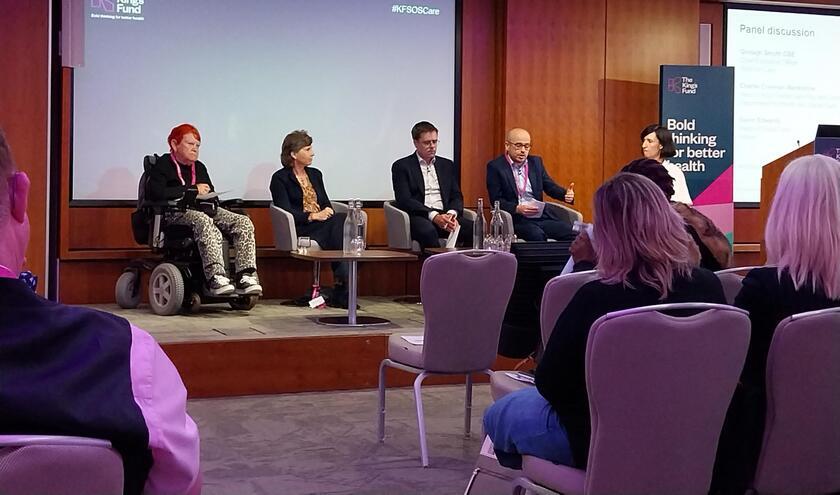
The Sorting out social care conference on 2 June discussed the prospects for finally addressing the fundamental issues facing the sector ahead of the publication of Baroness Louise Casey's initial report this week.
The big issues
In the opening panel, participants looked at the big issues facing social care and set out the priorities for action.
Vic Rayner, chief executive of the National Care Forum, said commissioning remained a significant challenge that could be made more difficult by local government reorganisation.
Rayner said immigration reforms were ‘a huge concern' with workers having to face hate crime and a climate of fear.
Kelvin Imoloame, support worker and vice chair, UNISON National Social Care Committee for England, said the workforce was not valued and viewed as unskilled.
‘We do the hardest job but we are paid the lowest,' Imoloame said.
Andrew Harrop, director, Public First, and former general secretary of the Fabian Society, said the Employment Rights Act with the Free Pay Agreement (see below) at its heart and fair funding reforms of local government finance were two significant steps taken by the Labour Government.
While highlighting the social care funding outlook had improved modestly, Harrop said the sector was just standing still.
Harrop said double the number of older people were receiving support 20 years ago than they were today.
He said social care had to become more of a national public service, adding Government needed to have an honest conversation about funding with the sector requiring an additional £15bn investment in the next 10 years.
Phil Holmes, president, Association of Directors of Adult Social Services and director of adults, wellbeing and culture, Doncaster Council, highlighted his concerns that ICBs were being taken further away from local communities through mergers.
Holmes said councils were also increasingly worried about the impact on their finances of less NHS CHC commissioning.
Fair Pay Agreement
In a panel assessing prospects for the Fair Pay Agreement (FPA), Charlie Coleman Mankletow, head of adult social care pay and careers, DHSC, gave an update on the policy's progress.
With the FPA due to be launched in April 2028, Mankletow said it was key that the UK learnt the lessons from New Zealand where legislation was introduced by the Labour Government in 2022 only to be later repealed by the following administration.
Gavin Edwards, head of social care at UNISON, said the FPA would create ‘political accountability at a national level for a sector that has been ignored'.
Edwards said: ‘It shines a light on an issue that has been ignored for far too long.'
Chief executive Jane Townson said The Homecare Association wanted to support the measure but added there was ‘huge anxiety' over whether providers will be able to meet the costs.
Townson said there was already a lack of provider compliance with the Minimum Wage due to underfunding.
She added: ‘I can't see any way of making this work unless the Government makes more money available to local authorities.'
The FPA will set at annual level agreed by employers and employees through collective bargaining through an Adult Social Care Negotiating Body. The Government has committed £500m towards the first annual settlement.
The panelists questioned whether an agreement could be reached without the involvement of local government in negotiations, with Townson calling for a national contract and national commissioning framework for the policy to work.
Neighbourhood health
In a later session focused on the role of social care in the development of neighbourhood health, Jeff Chinnock, associate director of partnerships, Royal Devon University Healthcare NHS Foundation Trust, shared how One Eastern Devon has taken a partnership approach led by a VCSE co-chair.
When asked by HM who represented social care within One Eastern Devon, Chinnock said it ‘varied over time', adding people from care homes ‘had dipped in and out'.
Chinnock admitted it was ‘easy to revert to your silos' where ‘working across boundaries became less important'.
‘My experience of the past four years is that partnerships vary but it's the intent and common purpose that keeps everyone aligned,' he said.
He acknowledged there was ‘still work to do' to keep social care fully engaged in delivery. ‘It's a partnership of the willing and we need more willing,' he said.
Melanie Weatherley, co-chair Care Association Alliance and chair, Lincolnshire Care Association, urged social care providers to fully engage in the development of Health and Wellbeing Board neighbourhood plans in order to avoid an NHS centred approach.
She said nursing homes could be an integral part of neighbourhood health through their step up and step down services.
Concluding, chair Caroline Abrahams, charity director, Age UK, said it was up to social care providers to 'keep fighting for the neighbourhood health we want to see'.