When Manchester University NHS Foundation Trust (MFT) began thinking about how to modernise its estate, the challenge was not a lack of data, but the opposite. Information about buildings, assets, space usage and safety risks existed in abundance, but it was fragmented across systems, spreadsheets and paper records, making it difficult for staff to access what they needed when they needed it.
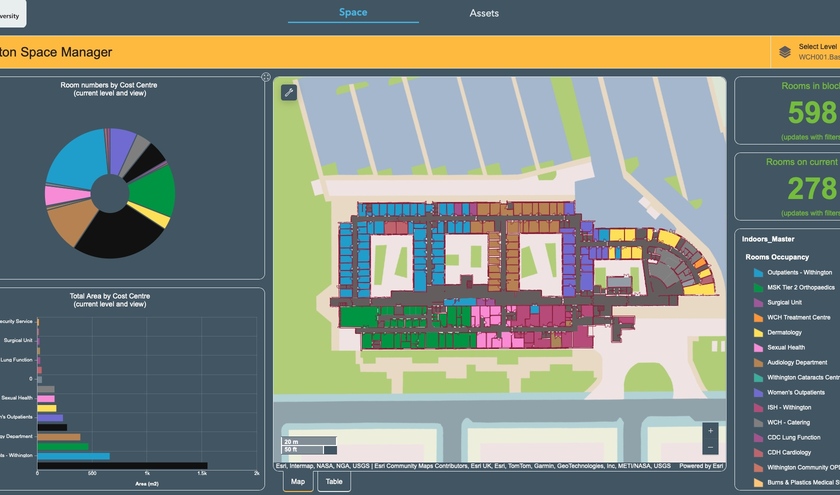
The solution has been the creation of a large-scale digital twin: a 3D, data-rich model of six hospitals that brings estates information together into a single, visual platform. The model represents a major step in MFT's wider digital transformation, designed to improve operational efficiency, strengthen safety and enable better decision-making.
‘We knew we had lots and lots of data, but it was all siloed in different areas,' says David Bailey, head of digital estates at MFT. ‘You couldn't see it all in one place. What we were trying to achieve was making accurate, trusted information available at the touch of a button.'
Single source of truth
Developed using Esri UK's Geographic Information System (GIS) platform and delivered with support from BIS Consult, the digital twin spans 274,000sq m of internal floor space. It includes Manchester Royal Infirmary, Royal Manchester Children's Hospital, Manchester Royal Eye Hospital and Saint Mary's Hospital on the Oxford Road campus, as well as Altrincham Hospital and Withington Community Hospital.
At its core, the model visualises every floor, room and space in 3D, with multiple layers of data connected to each location.
‘We have enterprise systems that collect data, but GIS allows us to bring it together spatially so people can actually understand it,' says Bailey.
A major early focus was improving the quality and consistency of spatial records. MFT was formed through the merger of multiple trusts, each with different standards for recording space and buildings. The indoor modelling capability of Esri's platform allowed the trust to modernise these records and create a reliable foundation for future applications.
Measurable benefits
The platform is delivering tangible operational gains. One of the most immediate impacts has been in safety-critical areas such as RAAC and asbestos management.
New mobile workflows allow staff to carry out digital surveys on-site, feeding data directly into the 3D model and visualising different levels of risk. At one hospital site alone, digitising asbestos management has cut the time needed to prepare information by up to 10 days per month.
For project managers, the efficiency gains are equally significant. Previously, understanding the scope of a refurbishment or maintenance project could involve days of chasing information from different teams.
‘Now a project manager can log in, select the rooms they're working on and instantly calculate floor areas, see asbestos data, view photographs and understand what assets are in that space,' says Bailey. ‘That answer might take minutes rather than a week.'
The model also supports better co-ordination between teams, giving operational managers visibility of where projects are happening and what data sits behind them.
Designed for adoption
A key principle behind the project has been usability. Rather than introducing specialist technology that only a few experts can access, the trust has focused on making the system work on standard devices.
‘If it works on the kit staff already have, it's far more likely to be adopted and become part of day-to-day routines,' explains Bailey.
Skills development has focused on transferring existing capabilities rather than building everything from scratch. The response from staff has been encouraging. ‘They start to see their data coming together, and that sparks ideas about how it could help them,' says Bailey.
Future growth
The next phase of development will bring the remaining four hospitals in MFT's estate into the digital twin and digitise building condition surveys to address the maintenance backlog. Energy usage data will also be integrated to support cost analysis and carbon reduction.
Beyond estates, it opens the door to new applications across the trust, including indoor navigation for patients and staff, contact tracing to help manage infection outbreaks, and real-time asset tracking to locate equipment more quickly.
‘There's huge potential once you've got that core understanding of space,' Bailey says. ‘You can then start layering in clinical, operational and financial data to support better planning.'
Lessons learnt
For organisations considering a similar approach, Bailey offers clear advice: start with the basics.
‘You can't start with the digital twin,' he says. ‘You have to start with your data, cleaning it, securing it and making sure people trust it. Space data is absolutely vital. If your drawings aren't up to date, that's where you need to begin.'
Equally important is clarity of purpose. ‘You need to be clear about what you're trying to achieve and build up to it over time,' Bailey adds.
As MFT's experience shows, when done well, a digital twin can be far more than a visual model - it can become a strategic asset, reshaping how a complex organisation understands and manages its physical estate.
David Bailey can be contacted at david.bailey@mft.nhs.uk